VERSES Research Summary
VERSES technology is on the cutting edge. This can make it hard to know where to start. This page provides an overview of our work.
VERSES’ research program is centered on a single premise: intelligence emerges from agents that continuously infer, learn, and act within uncertain environments. The lab’s work builds a coherent stack—from theoretical foundations to real-world applications—that demonstrates how this approach can scale from individual agents to networks of intelligent systems.
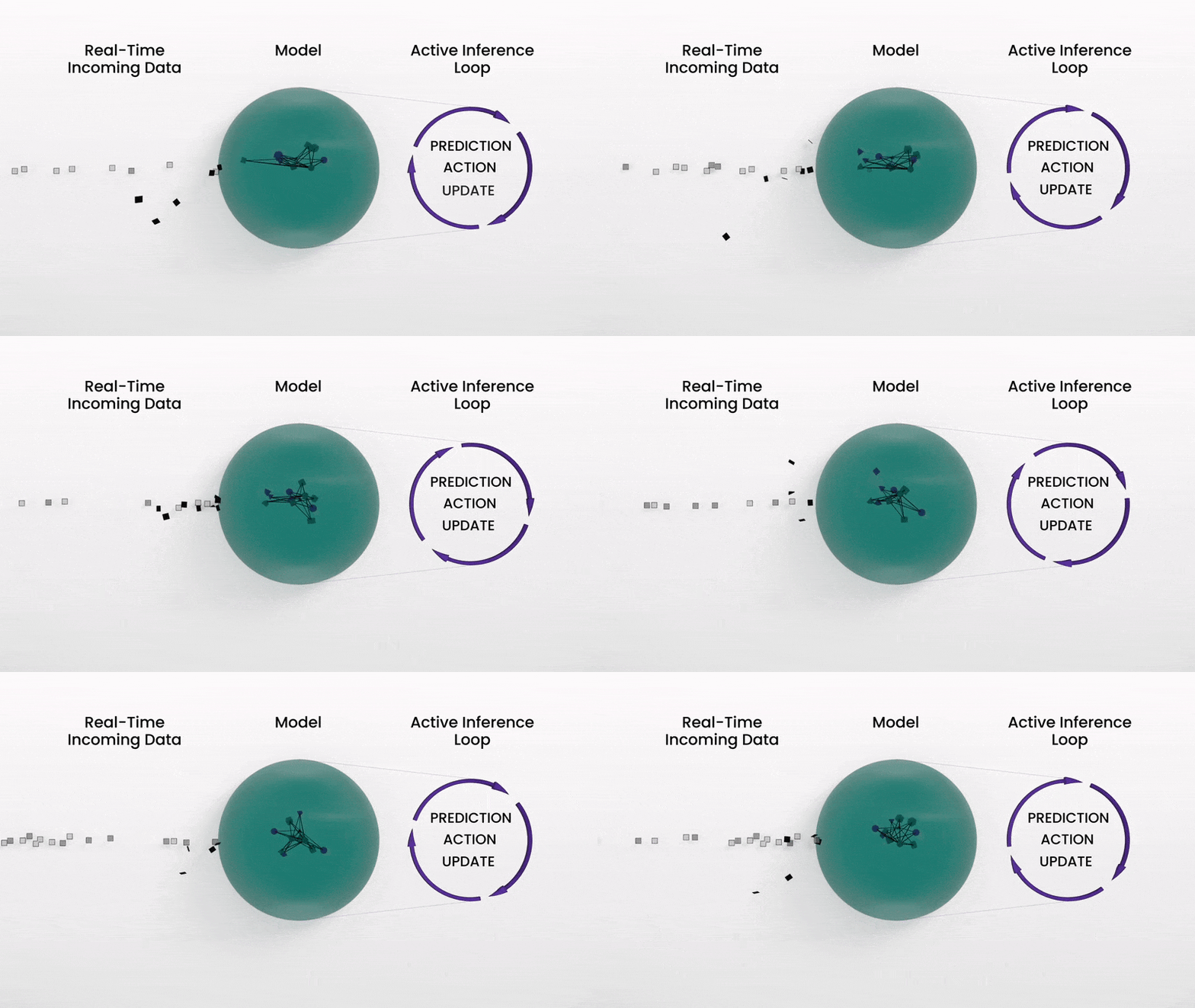
Intelligence is a process of active inference
The foundation of the research is the position paper Designing Ecosystems of Intelligence from First Principles, which formalizes intelligence as a process of Active Inference. In this framework, agents continuously update probabilistic models of the world and coordinate with other agents to minimize uncertainty. This work establishes the conceptual basis for intelligence as a distributed system of interacting agents rather than an isolated model.
Active inference can tackle real-world problems by using approaches that scale efficiently
Building on this foundation, the paper From Pixels to Planning: Scale-Free Active Inference introduces Renormalized Generative Models (RGM). These models allow agents to learn hierarchical world representations that connect perception directly to planning. The result is a unified generative framework in which sensing, reasoning, and action emerge from a single probabilistic model of the environment.

VERSES models can efficiently learn and update in real time
The next step addresses how agents learn structured environments efficiently. AXIOM: Learning to Play Games in Minutes with Expanding Object-Centric Models demonstrates that agents can construct object-centric world models that dynamically expand as environments become more complex. This approach allows agents to learn new environments rapidly and with far greater data efficiency than conventional reinforcement learning systems. Gameworld 10K is a challenge created to demonstrate these capabilities and has a direct, strong relevance to solving the ARC-AGI-3 challenge. The results of Gameworld 10K were independently validated by Soothsayer AnalyticsTM and are documented in this report.
VERSES models are well suited to real-world challenges such as robotics
For real-world deployment, perception of complex physical environments is critical. Variational Bayes Gaussian Splatting introduces a probabilistic method for real-time 3D scene reconstruction with uncertainty modeling, enabling agents to maintain continuously updated spatial representations of their surroundings.
These capabilities are then applied to embodied systems. The robotics work Mobile Manipulation with Active Inference for Long-Horizon Rearrangement Tasks demonstrates how perception, generative world models, and planning can be integrated into a single framework that enables robots to execute complex, long-horizon tasks in dynamic environments.
VERSES technology provides a suite of solutions that solve complex problems that span foundational research to real products
Taken together, these papers describe a progression from theory → world models → perception → planning → embodied intelligence, ultimately supporting VERSES’ broader vision of ecosystems of intelligent agents that coordinate through shared probabilistic models of the world. This architecture is designed to enable scalable intelligence across domains such as financial services, robotics, spatial computing, infrastructure systems, and autonomous decision environments.
In essence, the research demonstrates how Active Inference can serve as a unifying framework for building adaptive, world-model-driven AI systems capable of operating in complex real-world environments.
These capabilities are now embodied in VERSES’ product, Genius, launched commercially in April 2025.
Read more about our science
We've published 100+ papers in the last few years based on the Active Inference research performed by the VERSES research team, which is of major significance. The full list can be found on Google Scholar.
Here is an independent blog written by AI expert Devansh about VERSES.
How a Tiny AI Startup is beating OpenAI by Redefining Intelligence [Breakdowns]